Common vs Uncommon vs Rare Pokémon Cards: What's Actually Worth Keeping
September 14, 2026

Every Pokémon card has a small symbol in the bottom corner (usually bottom-right) that tells you its rarity at a glance. If you're sorting through an old collection or a box of bulk cards, knowing what to look for takes maybe an extra five seconds per card — and it's the single fastest way to separate "definitely bulk" from "worth a second look."
This system is defined in the official Pokémon TCG product guide, and Bulbapedia's rarity page has the full historical breakdown if you want to go deeper on older sets.
● Circle = Common
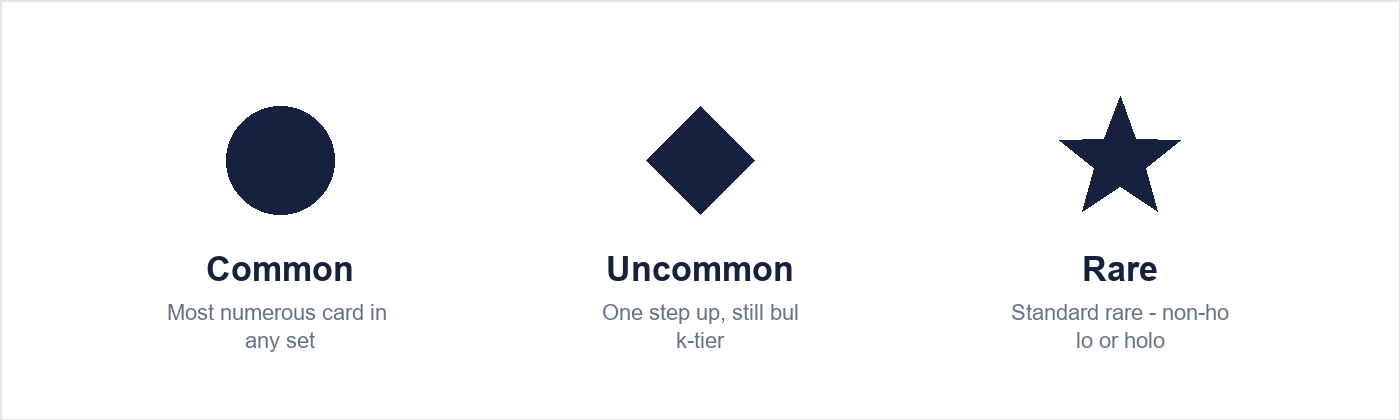
The most numerous card in any set by far. Commons are almost always basic Pokémon with simple, low-impact effects. In bulk, commons are worth a fraction of a cent each — real value, but only in volume.
◆ Diamond = Uncommon
One step up from common, usually evolved Pokémon or slightly more useful Trainer cards. Still very much a bulk-tier card individually, priced similarly to commons in most bulk rate cards.
★ Star = Rare
This is where it starts getting more interesting, and also where "rare" stops meaning just one thing. A plain black star is a standard (non-holo) rare — a real step up from common/uncommon, but still a fairly modest per-card value. A holo rare (look for the shiny, holographic treatment on the artwork) is worth meaningfully more — often 3-5x a non-holo rare in bulk pricing. Newer sets also use the star symbol for several tiers above standard rare (double rare, ultra rare, and so on) — which is exactly why the symbol alone isn't the full story on modern cards.
Modern sets: it gets more specific
Since the Sword & Shield era, Pokémon has used more granular rarity symbols and tiers beyond the classic circle/diamond/star system — things like Double Rare, Ultra Rare, Illustration Rare, Special Illustration Rare, and Hyper Rare, each with their own symbol or marking. The short version for a seller: anything bigger than a plain rare star, especially on a recent set, is worth a second look rather than an automatic sort into bulk.
The cards worth pulling out of bulk before you sell
- Anything holo — even a "just" holo rare is worth meaningfully more than its non-holo counterpart.
- V, EX, GX, VMAX, VSTAR cards — look for the card name ending in one of these, usually on a card with extra-flashy artwork or a full-art treatment.
- Full arts and secret rares — numbered higher than the set's total card count (e.g. "195/193") is a reliable tell that a card is a secret rare, almost always worth individual attention.
- Anything vintage — Base Set through the Neo era (roughly 1999-2002) commands a premium across every rarity tier, common included, just for being old.
Pulling these out as part of an actual reselling process rather than a one-time sort? See how to turn bulk into profit for the full process, from sourcing lots to listing the hits.
Know what you've got — now find out what it's worth.
Get a live quote based on your actual rarity breakdown.
Get Your QuoteEverything else is legitimately good bulk
The vast majority of any real collection — commons, uncommons, and plain non-holo rares — isn't worth the time of an individual listing. That's not a bad thing; it's just bulk, and bulk has a real, straightforward market of its own. Once you've pulled out the cards worth a second look, the rest is exactly what a bulk buylist is built to price fairly and buy in volume.
Not sure what you're looking at on a specific card? Our pricing guide breaks down real value ranges by rarity tier.