Pokémon Card Condition Guide: NM, LP, MP, HP Explained (For Sellers)
September 27, 2026

Condition is the single biggest variable in what any individual Pokémon card is actually worth — bigger than almost anything else short of the card itself. Before you sort, price, or sell anything, it's worth knowing what the standard grades actually mean.
The standard scale
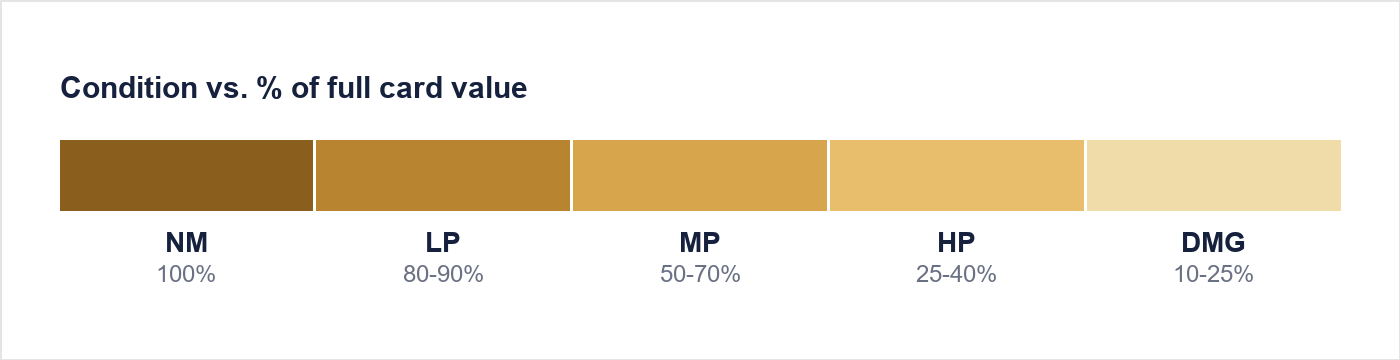
Most of the hobby (TCGplayer included) uses a version of this five-tier scale, roughly as a percentage of full "perfect" value:
- Near Mint (NM) — no visible defects under normal inspection: crisp edges, no visible scratches, holo pattern fully intact. Sells at full market price. A tiny factory print variation or very slightly off-center print doesn't disqualify a card from NM — that's different from handling wear.
- Lightly Played (LP) — roughly 80-90% of NM value. Minor wear visible on close inspection but not obvious at a glance: a small edge nick or two, faint surface scratching confined to the border, very light whitening on one corner.
- Moderately Played (MP) — roughly 50-70% of NM value. Wear that's visible without close inspection: more noticeable corner whitening, visible surface scratches, some edge wear.
- Heavily Played (HP) — roughly 25-40% of NM value. Significant wear: heavy whitening, noticeable creasing, visible scuffing across the surface.
- Damaged (DMG) — roughly 10-25% of NM value, sometimes less. Water stains, ink, tears, peeling, or heavy creasing that goes beyond cosmetic wear. Little to no market value unless the card is independently rare enough that condition barely matters.
How to actually check condition in a few seconds
The fastest reliable technique: hold the card at an angle under a consistent light source (a lamp or window works) and slowly rotate it. This "raking light" trick reveals surface scratches and print lines that are completely invisible when you look at the card flat under overhead lighting. Combine that with a quick check of all four corners for whitening and the edges for nicks, and you've covered the vast majority of what separates NM from LP.
Why this matters more for bulk sellers than you'd think
If you're selling a mixed bulk collection rather than individual graded cards, you're not going to condition-grade every single commons — that defeats the purpose of selling bulk in the first place. But it's still worth one pass to pull out anything genuinely damaged (water stains, major creases, torn corners) before you sell, for two reasons: most bulk buyers price assuming played-but-intact condition, not genuinely damaged cards, and a collection with a few heavily damaged cards mixed in can get an unnecessarily conservative quote if a buyer can't quickly tell how much damage is actually in the box.
This is exactly why a pre-ship checklist matters — confirming cards are NM/LP condition and unsleeved before you box them up is one of the fastest ways to make sure your quote actually matches what you get paid, with no surprises after a buyer opens the box.
For a genuinely valuable individual card, professional grading (via a service like PSA) goes well beyond this basic check — but that's a different decision for your best single cards, not something to do for bulk.
What this means for your bulk sale
You don't need professional grading tools or a magnifying loupe for a bulk sale — the raking-light check and a quick look at corners and edges is enough. Pull anything genuinely damaged into its own pile (it may still have minor bulk value, just not the same rate), and the rest is standard bulk condition, exactly what a buylist rate is built around.
Ready to see what your collection is worth? Get a quote — our pre-ship checklist walks you through condition requirements before you ship.
Already sorted by condition?
You're ready for an accurate quote — see live rates now.
Get Your Quote